While travelling through South America, I've spent a lot of time in taxis. Some have been good taxi rides, others have been terrifying. You never know, when you get in a taxi, which one it's going to be.
One of my favourite taxi rides was in Colombia. My sister and I went to a free rock concert in Bogota, held about thirty minutes away from the centre of town. At the end of the concert we jumped into a taxi for the ride back.
"Hello, beautiful girls", the taxi driver greets us. He flicks the light on and turns around to get a better look. "Yes, very beautiful", he nods. "Beautiful girls are trouble though. Do you know why?" We shake our heads.
"They're expensive", he says, rubbing his fingers together. "They want the Mercedes, the nice house, pretty clothes. You give them money, money, money. Muy costoso".
We nod. He looks at us. "Mercedes are expensive here", he says. He adds this as though Mercedes might be cheap in other places.
The taxi driver then tells us a bit about himself as we drive along. He asks us where we're from. We go through the requisite question-and-answers, which usually go like this:
"Where are you from?"
"New Zealand"
"Ah, New Zealand! It's a beautiful country"
"Thank you "
"So you speak Dutch?"
"No, English"
(Pause) "But New Zealand is in Europe?"
"It's in Oceania"
"Oceania! How far away is it on a plane?"
"About twenty-four hours"
"That's very far away!"
"Yes, it's very far away."
"Do you have husbands? Boyfriends?"
"No"
"Don't worry. You can get Colombian boyfriends"
This is said reassuringly, as if we're worried. He glances back at us.
"My girlfriend is black", he says. ("Mi novia es negrita"). He pauses. "But I like her".
At first I think, how nice, he used the diminutive to refer to his girlfriend - "My novia es negrita", rather than just negra. Later I think he may actually have meant "My girlfriend is a little bit black".
Nicola
Showing posts with label colombia. Show all posts
Showing posts with label colombia. Show all posts
Wednesday, August 18, 2010

Wednesday, July 7, 2010
The chiva ride
Bumpy ride on a pimped-out chiva to Tairona National Park in Northern Colombia.
Chivas are a Colombian mode of transport, using the base of a bus or truck with a modified body made out of either metal or wood. Seats are wooden benches, and they have doors instead of windows.
Our chiva driver could not have had more lucky charms in the front of his chiva. Horseshoe, check. Requisite photo of a patron saint, check. Three crosses, check. Spanner so he could get out and tighten the front tyre every 20 minutes..um..check.
We had about five people in our little chiva and it was struggling with 20km an hour. We had to stop a few times so the driver could tighten the aforementioned front tyre. But that didn't stop this guy trying to overtake everything around him.
Nicola
Saturday, July 3, 2010
Guatapé


Guatapé, a cute lakeside town two hours from Medellín. The tiny chivas and the brightly painted houses lend a kind of Disneyland feel to things.
Something sweet?
.jpg)
Colombia's obsession with sweet things is not doing me any favours. Ok it's my obsession with sweet things, and I'm not doing myself any favours by being in Colombia, Land of Delicious Sweet Things. Today it was sweet doughy bread filled with arequipe, a caramel sauce similar to dulce de leche. And a cinnamon roll. And half a Gol bar. The problem is there are so many sweet things available here, and I’m the kind of person who wants to try everything – so needless to say I’ve been eating a lot.
Arequipe, cinnamon rolls, tres leches cake, milk fudge, dark chocolate, gelato, peanut squares. They’re available everywhere. They’re even available on the public transport, which is something I initially found really odd. Buses are one of the best places to buy snacks. There are people who seem to make a living hopping on and off public transport and selling food to the passengers.
An example: a couple of days ago we took a bus to Guatapé, a cute Disney-esque lakeside town two hours from Medellín. On the two hour bus trip we had no less than eight different people hop on and off the bus peddling their wares.
It goes something like this. A man hops on the bus (it’s usually a man), wipes the sweat off his face with a hankerchief and introduces himself.
“Hello, good day, my name is Diego Estéban Ramirez". (Pause. Wipe brow). "Today, I have with me chocolate bars. These are imported chocolate bars, ladies and gentlemen, of excellent quality. I have two flavours - " He produces them with a flourish "Rollero and Golpe Black” (He proceeds to hand them out) “Here you go, here you go, here you go”. (We all sit there, having a moment with the chocolate bars. The first time this happened I thought, ‘Yay – free chocolate!’, but this is just so you can look at it). Diego Estéban Ramirez (or whoever he is) goes back along the bus collecting them up again. “Thank you, thank you, thank you. This is a very economical price today ladies and gentlemen, just a thousand pesos for both” (less than £1) “Two for you Sir? Thank you. And for you? Thank you”. Our host collects up any money and/or remaining chocolate bars, then hops off the bus.
They aren’t always that lengthy. Sometimes people just jump on and move quickly up the aisle, firing off their produce as they go: “agua-jugo-gaseosa” (‘water-juice-soft drink’) or “pan-mani-chuchirron” (‘bread-peanuts-pork crackling’) until somebody puts their hand out. Or not.
The curious part for me is that the buses actually pull over to pick these people up. Most commonly they’re selling dry breadsticks and round wafers, or bags of chip and pork crackling. Surely the buses could sell this stuff themselves, but no. It’s a surprise every time. On the way to Guatapé we were also treated to a fifteen minute presentation from a man trying to sell (pirated) children’s DVDs - but I’m only interested in the sweet things, of course.
Nicola
Thursday, July 1, 2010
Taganga


Taganga itself wasn't hugely impressive, but it was just a twenty minute walk through cactusus and red sand to get to the beautiful Taganga coastal beaches.

Monday, June 28, 2010
An update mostly about food and a little bit about insects

It's our last day in Santa Marta and it's suffocatingly hot, although we've been drinking a lot more water since we found out you can buy it in a bag for much cheaper than a bottle. A 1.75 litre bottle of water is approx $2 and a 5L bag of water (though a little inconvenient) is much more affordable at $1.10. You get dehydrated here really quickly, mostly because of the heat, but also we've been doing a lot of walking and all the food here either is full of sugar or salt (or both).
It's a bit more expensive in Colombia for food than it is in Ecuador. In saying that, you can still eat pretty cheaply if you want to. Street food is cheap, if you don't mind a deep fried egg roll or cheesy dough ball for breakfast, or alternatively bags of fresh mango are about 70 cents. Then for lunch, it's $4 for a massive plate of rice and beans and fish/chicken/meat with soup as a starter and a glass of juice. One thing Colombians do really well is fresh juice. They sell lime juice and fresh fruit cocktails by the glass on the side of the street for about 70 cents and it's always nice and refreshing.
This morning I didn't wake up until 10am (we didn't really have any plans today). We had some muesli and yoghurt for breakfast and a black coffee (which is only 35 cents for a cup). It's so, so hot in our room that you always wake up in a feverish sweat, although I'm getting used to it by now. The showers are always the pipe-through-the-wall type with a single stream of cold water which is actually really nice in the heat.
There aren't too many insects in our hostel, although while we were in hammocks there were plenty of massive toads, spiders, cockroaches and even a baby boa constrictor (which was climbing into a boy's hammock, probably trying to find somewhere to curl up and go to sleep to digest the toad it had just eaten).
And to tie the topics of this post together (Colombia, food and insects), the specialty food in Barichara is "hormigas culonas", which is fried ants (literally "fat-bottomed ants"). Apparently they taste like a mixture of dirt and old coffee grounds. I probably won't be trying them.
Nicola
Sol y Sazon in Santa Marta
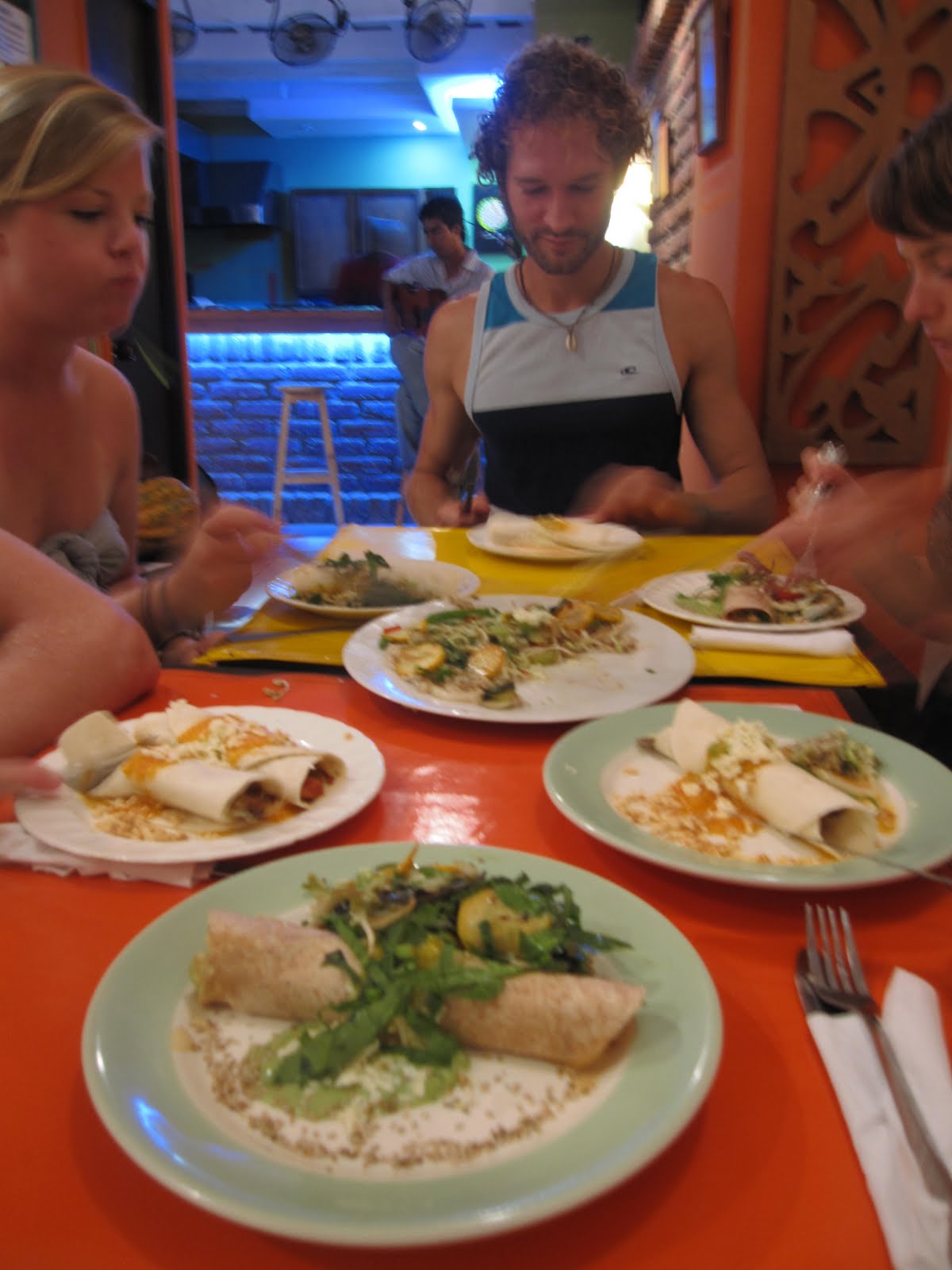
We had an amazing meal last night - by far the best meal in Colombia so far, and possibly the best burrito I've ever had - in a restaurant that just started up a couple of weeks ago.
The name of the restaurant is Sol y Sazon ("Sun and Flavour"). The owner/chef had only a few items on the menu as he's still testing it out, so we didn't really choose our meal, he just told us what he was cooking that night. Luckily, it all sounded amazing.
To start, the three of us shared a grilled potato, capsicum and spinach salad with a delicious lemony peppery dressing. I couldn't help dipping my fingers in to wipe up the excess dressing, which was more like a thin sauce, before the plate was taken away. For our main we each had a burrito. Claire's was a chicken burrito with a mango sauce and Stacey and I each had a spinach, feta, peanut and roasted vegetable burrito. It was small and perfectly put together, with everything made from scratch including the tortilla, which was thin, almost like a crepe, and melted in my mouth. It so delicious that I savoured it and I enjoyed every mouthful.
There was also a glass of freshly squeezed mora juie (like blackberry juice). You always have fresh juice with meals here, and Colombians do fresh juice really well. To finish we were given some sweet banana, on the house.
All up the meal cost us the same or less than other meals we've had locally, and was by far superior. There was so much care and love put into each course and every ingredient was chosen with care and complimented the rest perfectly. Our host came out after each plate was brought out to ask us what we thought of the food. Honestly, I wanted to marry this guy just so he could cook for me. It was like going to dinner at your friend's house, if your friend was a Colombian gourmet chef.
You can view Sol y Sazon on Facebook: http://www.facebook.com/pages/Santa-Marta-Colombia/SOL-SAZON/137219238761?v=info
Wednesday, June 23, 2010

Cogi Family

An indigenous family living in the mountains near La Ciudad Perdida. This family were Cogi (the ancestors of the Lost City inhabitants).
One of the highlights of the trek was talking to the local indigenous family at one of the camps, who were Wewu (seperate from the Cogi). They spoke good Spanish as well as their native language, and they had learnt a little English.
The father of the family, who was probably our age (and whose name I could neither pronouce nor spell) showed us all his crops (plantain, potato, coca) and told us about his family. We taught him some English words and he taught us some words in Wewu. The family was pretty well off (they had two horses and owned the land that we were staying on), but they were still very isolated. He had a notebook with drawings but didn't actually have a pen, so I gave him mine. Their house was made of mud and stone and they wore simple, white sack dresses or toga-like gaments, but they all carried these intricately woven coloured bags and the girls and women wore beautiful beaded necklaces. They were one of the few Wewu familes around as the two local village clusters were both Cogi familes, and they were almost entirely self-sufficient.
Nicola
Tuesday, June 22, 2010
La Ciudad Perdida (Trek to the Lost City)
We've just spent six days in the jungle on a trek to La Ciudad Perdida (The Lost City) in Colombia. This has been my first chance to use the internet - as well as have a shower, do laundry, put on clean clothes and do lots of other things I usually do every day back home.
We signed up for the Lost City Trek on our first day in Santa Marta. The entire trek worked out at about NZ$50 per day and included two guides, entrance to the Lost City, six days of accomodation, food, water and mules to carry our food. It was amazing. I have never been more sweaty, dirty or fatigued than I have been over the last six days. Luckily the group we were in was a really cool group and everyone got along really well. There were 12 of us in total - four Kiwis, four Americans and four Brits.
We took the trek pretty slow, only doing a few hours each day, but with the sun and rain beating down and carrying all our stuff on our backs it was pretty hard. Not hard for our guide Miguel, who was pretty much cartwheeling up the hills while carrying an entire supermarket on his back. We slept in hammocks each night and our guides cooked us delicious food that was totally unsuitable for hiking, like empanadas and deep fried dough balls. We drank water straight from the river (so far so good). We also washed in the river.
The distance to the Lost City was 45km there and back, but it was a rough road and we had to cross the river about 107,546 times. At one point I asked Miguel whether the river was dangerous to cross (as it rained heavily at 3pm every dayand the water had risen to our shoulders).
"For sure, it's dangerous" he said confidentally, "but it's not a problem".
There was once when Miguel decided the river was in fact too high to cross, so he whipped out his machete and hacked a path through the jungle for us. It was the most hazardous path I have ever been on. I actually feared for my life. After that I was almost bounding across the rivers and never asked him again.
The actual Lost City was 'Lost' until 1975, when some explorers (read: gold robbers) came across it and plundered everything. Since then, local guides have been taking tourist treks to the city, and groups were even able to camp in the ruins until four months ago (Some people were taken hostage by the paramilitary and tourists were ruining it anyway). There were 1200 (extremely slippery and hazardous) steps to get up to the city and it was an amazing sight. Only the foundations of the city remain but a couple of replica houses have been constructed, which are actually the same as the houses the local indigenous people live in now.
The city itself was swarming with mosquitos. We were absolutely eaten alive by them (but it was worth it). I lost my repellent so I used someone else's, but I am still able to count 102 bites on just one leg.
Nicola
We signed up for the Lost City Trek on our first day in Santa Marta. The entire trek worked out at about NZ$50 per day and included two guides, entrance to the Lost City, six days of accomodation, food, water and mules to carry our food. It was amazing. I have never been more sweaty, dirty or fatigued than I have been over the last six days. Luckily the group we were in was a really cool group and everyone got along really well. There were 12 of us in total - four Kiwis, four Americans and four Brits.
We took the trek pretty slow, only doing a few hours each day, but with the sun and rain beating down and carrying all our stuff on our backs it was pretty hard. Not hard for our guide Miguel, who was pretty much cartwheeling up the hills while carrying an entire supermarket on his back. We slept in hammocks each night and our guides cooked us delicious food that was totally unsuitable for hiking, like empanadas and deep fried dough balls. We drank water straight from the river (so far so good). We also washed in the river.
The distance to the Lost City was 45km there and back, but it was a rough road and we had to cross the river about 107,546 times. At one point I asked Miguel whether the river was dangerous to cross (as it rained heavily at 3pm every dayand the water had risen to our shoulders).
"For sure, it's dangerous" he said confidentally, "but it's not a problem".
There was once when Miguel decided the river was in fact too high to cross, so he whipped out his machete and hacked a path through the jungle for us. It was the most hazardous path I have ever been on. I actually feared for my life. After that I was almost bounding across the rivers and never asked him again.
The actual Lost City was 'Lost' until 1975, when some explorers (read: gold robbers) came across it and plundered everything. Since then, local guides have been taking tourist treks to the city, and groups were even able to camp in the ruins until four months ago (Some people were taken hostage by the paramilitary and tourists were ruining it anyway). There were 1200 (extremely slippery and hazardous) steps to get up to the city and it was an amazing sight. Only the foundations of the city remain but a couple of replica houses have been constructed, which are actually the same as the houses the local indigenous people live in now.
The city itself was swarming with mosquitos. We were absolutely eaten alive by them (but it was worth it). I lost my repellent so I used someone else's, but I am still able to count 102 bites on just one leg.
Nicola
Subscribe to:
Posts (Atom)
